Services
Elevator Reliability Engineering & Root Cause Analysis


Whether you are a business owner, architect, or project manager, we are here to assist you. Elevate your inquiry by filling out the form below. Provide us with some initial details about your project, and we'll get back to you promptly with a customized elevator solution.
Elevator Reliability Engineering & Root Cause Analysis: Strategies to Eliminate Downtime and Restore System Performance
Elevator systems are a vital part of today’s infrastructure. They help transport people vertically in commercial, industrial, healthcare, and residential buildings across the United States. When elevators break down frequently, routine maintenance usually does not fix the root problems. Elevator reliability engineering and root cause analysis identify the specific mechanical, electrical, and system issues that cause these repeated failures. This method provides targeted solutions instead of temporary fixes.
Elevator safety and reliability go beyond routine inspections. Reliability analysis focuses on controller behavior, drive performance, braking response, door operator faults and communication system integrity to predict failures before they happen. This approach reduces downtime, lowers maintenance costs and extends the lifespan of equipment.
We cover the core principles of elevator reliability engineering, failure analysis methodologies, and answers to the most common questions property owners and facility managers have when dealing with persistent elevator performance issues.
Industrial Elevator Reliability Engineering Services for Maximum Operational Performance
Industrial facilities need elevators to run continuously to keep operations running smoothly. This helps move people and materials efficiently and maintains overall productivity. Reliability engineering services can find problems before they lead to costly disruptions and system failures.
Elevator Failure Analysis Experts for Industrial System Diagnostics
Industrial elevator systems work under tough conditions. They carry heavy loads and operate continuously in environments where precision is important. Our experts analyze elevator failures using advanced engineering techniques to find hidden problems and repeated mechanical or electrical issues. We check for errors in controller communication, inconsistencies in traction motors, braking problems, sensor calibration errors and issues with load management.
When we investigate elevator system failures carefully, we find the real causes of problems instead of just treating the symptoms. This helps make the system more reliable, extends the life of the equipment and ensures it works consistently. Facilities can then use specific corrective actions that reduce costly interruptions.
Our diagnostics focus on
- Elevator controller fault analysis
- Drive system performance evaluation
- Brake response testing
- Relay and circuit integrity inspections
- Door operator reliability assessment
- Load sensor calibration analysis
Frequent elevator breakdowns can disrupt production. Our engineering solutions turn these repeated failures into stable performance. We make sure industrial elevators are reliable, efficient and optimized for tough working conditions.
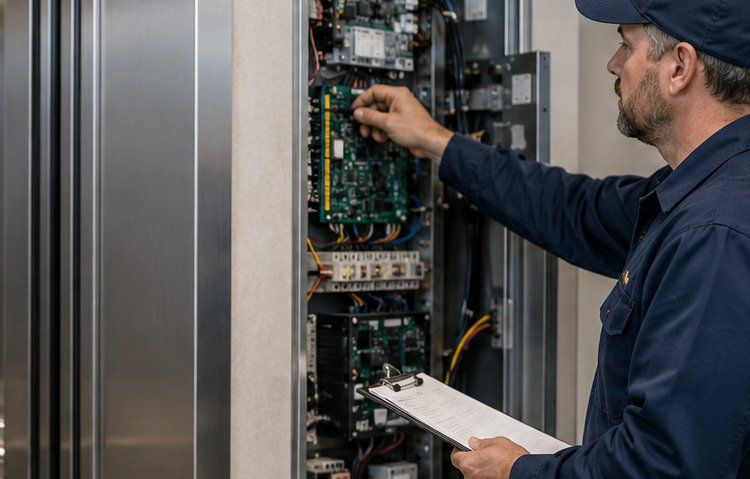
Elevator Downtime Reduction Services Through Root Cause Engineering Analysis
Frequent elevator outages cause delays, safety risks and extra costs. Our elevator downtime reduction services use engineering methods to find and fix these recurring issues. We focus on creating reliable solutions to prevent future problems.
We look at several factors to understand why elevators have downtime. These include operational logs, fault history, maintenance records, response times, environmental conditions and control system issues. By carefully examining these areas, we can find hidden problems that regular maintenance checks might miss.
Our reliability-driven methodology delivers measurable performance improvements by targeting systemic weaknesses.
Downtime reduction solutions include
- Operational pattern monitoring
- Fault sequence mapping
- Controller response diagnostics
- Predictive failure modeling
- Mechanical wear trend analysis
- Corrective engineering implementation
Property owners enjoy better uptime, fewer emergency repairs and happier tenants. Elevator reliability should be based on data, not guesswork. If your elevator is out of service more often than it's moving, our performance optimization services can help get it back on track.
Elevator Maintenance Reliability Engineering for Long-Term Asset Performance
Traditional maintenance usually focuses on quick fixes instead of improving overall reliability. Our approach to elevator maintenance consulting emphasizes long-term performance, predictive diagnostics and proactive steps to prevent issues.
We diagnose elevator maintenance problems to find patterns that cause early wear, inconsistent performance, and avoidable failures. We check lubrication schedules, how mechanical stress is distributed, the stability of electronic communication and how well subsystems work together.
Our engineering-focused maintenance optimization includes
- Reliability-centered maintenance planning
- Lifecycle degradation analysis
- Preventive replacement forecasting
- Maintenance schedule refinement
- Component performance benchmarking
- Failure probability assessment
This strategy helps reduce unexpected downtime and lower operating costs over the elevator's lifespan. Elevators should work smoothly without needing constant supervision. Good reliability engineering allows your system to run reliably, predictably and efficiently year after year.
Industrial Elevator Root Cause Analysis Consulting for Permanent Failure Resolution
Ongoing elevator problems need more in-depth investigation than regular troubleshooting can provide. Root cause engineering finds the source of technical failures and offers solutions that stop recurring issues. This approach improves the long-term reliability of elevators.
Elevator System Diagnostics Consulting and Fault Detection Analysis
Modern elevator systems produce a lot of operational data, but without expert analysis, important warning signs can be missed. Our consulting services for elevator system diagnostics turn this data into clear engineering insights you can act on.
We identify elevator faults by analyzing controller logic and performance metrics to detect anomalies affecting efficiency.
Diagnostic services include
- Controller software evaluation
- Sensor calibration verification
- Communication fault tracing
- Motor current analysis
- Door operation diagnostics
- Performance deviation tracking
Clear diagnostics allow us to respond quickly and minimize service interruptions, enhancing elevator reliability. Our engineering team monitors performance signals to address issues early.
Elevator Reliability Audit Services and Performance Optimization Consulting
Our elevator audit services help building owners and facility managers understand the condition of their systems. We find potential problems and point out ways to improve performance.
We provide detailed consulting for optimizing elevator system performance by assessing lifecycle efficiency, maintenance effectiveness, subsystem integration, traffic handling capabilities and historical fault trends.
Optimization services include
- Reliability benchmarking
- Lifecycle performance analysis
- Maintenance program evaluation
- System modernization recommendations
- Traffic flow efficiency review
- Operational improvement planning
The outcome is a plan for improved uptime, reduced service costs and enhanced asset value. Elevators are vital infrastructure investments and strategic optimization protects and boosts their operational reliability.
Still searching for "Elevator Consultant Near Me?"
Look no further! Call us at
(224) 500-0321 to get started
Frequently Asked Questions
Elevator reliability engineering focuses on diagnosing problems and identifying root causes rather than just providing temporary fixes. By analyzing fault codes, operational logs, drive performance and aging components, building owners and facility managers can pinpoint causes of downtime, allowing them to make more informed decisions about their elevator systems.
How is reliability engineering different from routine elevator maintenance when failures keep recurring?
Elevator maintenance includes regular inspections, lubrication, and replacing parts at set intervals. It also involves fixing things when they break down. This maintenance keeps the elevators working but does not look into the reasons behind repeated failures.
Reliability engineering takes a straightforward approach. We look at how failures happen, check fault histories, and test subsystem performance under load to find out why problems keep occurring. Our goal is to fix the root causes instead of just resetting faults.
When failures keep recurring despite regular maintenance, that is a diagnostic signal. It means the underlying cause has not been identified. Reliability engineering uses measurement, analysis and engineering judgment to close that gap and deliver stable, predictable performance.
What steps are involved in a structured root cause analysis for repeated elevator shutdowns or faults?
A structured root cause analysis starts with a complete review of fault data. We collect controller fault logs, maintenance records, callback history and notes from building staff or elevator technicians.
From there, we move into physical inspection and functional testing. This includes:
- Controller diagnostics — reviewing fault codes, logic behavior and communication errors
- Drive system evaluation — testing variable frequency drive (VFD) response, motor performance and speed regulation
- Brake performance testing — verifying stopping accuracy, brake torque and release timing
- Door operator analysis — measuring open/close cycle times, force levels and sensor responsiveness
- Sensor and safety circuit review — checking for calibration drift, intermittent contacts and signal integrity issues
After we finish testing, we look at the results from each subsystem. This helps us find out if the fault comes from a specific component or if it points to a bigger issue. Next, we create a prioritised action plan with clear technical recommendations instead of general suggestions.
Which elevator subsystems most commonly drive intermittent outages (controller, drive, brake, doors, sensors) and how are they tested?
Door systems are the most frequent source of elevator faults in commercial and industrial buildings. Door operator motors, clutch mechanisms, safety edges and light curtains generate a high volume of nuisance faults that can trigger shutdowns. We test door systems by measuring cycle forces, timing and sensor response across multiple cycles under normal operating conditions.
Controllers are a major source of intermittent faults, affected by heat, humidity, aging components and electrical noise. We test them by reviewing fault codes, inspecting circuit board components and evaluating operational logic behavior.
Drive systems, particularly VFDs, introduce faults related to voltage fluctuation, thermal stress, and parameter drift. Brake systems generate intermittent issues when brake coil voltage is inconsistent or mechanical wear causes irregular stopping. Sensors — including load weighing devices, leveling sensors, and position encoders — drift out of calibration over time and produce faults that are difficult to trace without precision measurement tools.
How can operational logs, fault codes, and maintenance history be used to pinpoint the true source of downtime?
Fault codes stored in elevator controllers record the conditions present at the moment a fault occurred. When reviewed across a time range, these logs reveal patterns — specific times of day, temperature conditions, load levels, or operational sequences that consistently precede a shutdown.
Maintenance records show what we inspected, adjusted or replaced and when. We compare maintenance activities with the dates when faults occurred to see if previous repairs fixed the issue or just moved it to another area. In many cases, if faults reappear soon after a repair, it means we may not have fixed the right part.
Callback history and staff observations offer crucial context beyond fault logs. Combining these sources allows us to create a clear timeline of system behavior and identify the likely cause of downtime.
Can a reliability audit improve performance and uptime on aging equipment without requiring immediate modernization?
Yes. A reliability audit evaluates the current condition of existing equipment and identifies which components are causing performance loss without assuming that full modernization is the only path forward.
Old elevator systems often have clear problems that can lead to breakdowns. Common issues include worn contactors, degraded drive settings, misaligned door operators, and bad safety circuit connections. Fixing these specific problems can improve how often the elevator works without needing to replace the entire system.
We examine how much life is left in each component and the risk of failure. We also look at how each part impacts the overall reliability of the system. This helps building owners determine which repairs will give the best return on investment and which can be delayed. Sometimes, modernization is the best choice. However, a reliability audit ensures that decisions are based on solid engineering data, not just assumptions.
What are the main benefits and risks of integrating connected smart elevator controls into an existing building system?
Connected smart elevator controls offer real-time fault monitoring, remote diagnostics, predictive maintenance alerts and performance data that building operators can access without waiting for a scheduled inspection. For facilities managing multiple elevators or high-traffic systems, that visibility reduces response time and allows maintenance teams to act on developing issues before they cause shutdowns.
The risks involve integration compatibility, cybersecurity and system complexity. Older elevator controllers may require interface hardware or software bridges to communicate with modern building management platforms, and those integration points introduce potential failure paths if not engineered correctly.
Cybersecurity is important. Systems that share data over a network need strong access controls, encrypted communication, and clear software update procedures. Without these, connected elevator controls can compromise a building’s security.
We evaluate compatibility, communication architecture and security requirements before recommending any connected control integration to ensure the performance benefits are not offset by new operational or technical risks.
Take Control of Your Elevator Performance Today
Reactive maintenance uses up budget and often leads to the same problems happening again. A proactive engineering approach helps you control, stabilize and improve the long-term performance of your vertical transportation systems.
Book your elevator root cause analysis consultation now and eliminate recurring issues with precise, engineering-driven solutions that restore consistent performance.
Keep your elevators moving efficiently—without the surprises, service interruptions or unnecessary stress.